
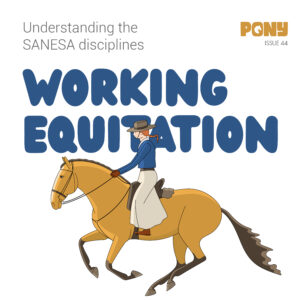
Imagine riding through obstacles like opening gates, crossing bridges, and weaving through barrels – all the things a real working ranch horse needs to do! That’s Working Equitation, and it’s one of the most practical, fun, and exciting equestrian sports you can try!
What IS Working Equitation?
Working Equitation was created to celebrate and preserve the riding skills developed in countries where horses are used for real farm and ranch work. Think of the cowboys and gauchos who need their horses to open gates, cross water, move cattle through narrow spaces, and navigate rough terrain – all while staying balanced and in control!
This discipline takes those real-world ranch skills and turns them into an organised sport. The result? A discipline that’s practical, cultural, and absolutely brilliant fun!
What makes Working Equitation special:
- Any breed welcome: You don’t need a specific type of horse – any breed can compete!
- Any style of riding: You can ride English, Western, or even Portuguese traditional style!
- Real-world skills: Everything you learn is actually useful for everyday riding.
- Three exciting phases: Dressage, obstacles, and speed!
- Builds partnership: Your horse becomes a true partner who can handle anything.
The three phases
Working Equitation competitions have three phases (though beginners only do two). Each phase tests different skills!
Phase 1: Dressage Test
Just like in regular dressage, you perform a test with specific movements in a 20m x 40m arena. This shows that your horse is well-trained, obedient, and moves correctly.
What you’ll do:
- Walk, trot, and canter (depending on your level)
- Circles and changes of direction
- Transitions between gaits
- Show that your horse is balanced and listening to you
The dressage test can be called (someone reads out the movements), but you’ll lose five points. It’s worth memorising it if you can!
Phase 2: Ease of Handling (the obstacle course!)
This is where Working Equitation gets really fun! You navigate a course with eight to 14 obstacles that simulate real challenges a working horse might face on a ranch or farm.
Typical obstacles include:
- Gate: Open, pass through, and close a gate without dismounting
- Bridge: Walk, trot, or canter calmly over a raised bridge
- Slalom: Weave through poles in a serpentine pattern
- Barrels: Ride a figure-eight pattern around barrels
- L-shaped corridor: Navigate through a narrow corridor showing control
- Side-pass: Move your horse sideways over poles
- Retrieve a pole/garrocha: Pick up and carry a long pole
- Ring and pole: Spear a ring with a pole (like a knight!)
Each obstacle is numbered, and you ride them in order. Judges score you on how calmly, precisely, and stylishly you and your horse handle each challenge!
You can walk the course beforehand; this means you get to walk around (without your horse) and look at all the obstacles before you ride! Judges and coaches will be there to answer questions.
Phase 3: Speed Phase (or second obstacle round)
For beginners (Levels 0-1):
You ride a second, shorter obstacle course and get scored just like the first one. No rushing – it’s all about quality!
For advanced levels (Levels 3 and up):
Now it’s a race! You ride through obstacles as fast as you can while still doing them correctly. Time matters, but accuracy matters more!
- Going fast? You could earn bonus time deductions!
- Knock something down? That’s 5 seconds added to your time
- Complete obstacles perfectly AND quickly? You could win!
[Subhead] SANESA Working Equitation Levels
Level 0 – Introductory (Lead Rein or Independent)
Lead Rein: Someone leads your horse while you focus on the obstacles. Perfect for absolute beginners!
Independent: You ride on your own!
- Walk and trot only (more than 3 canter strides = elimination)
- 8-10 obstacles in Ease of Handling
- Second obstacle round instead of speed
- Any legal tack allowed
Level 1 – Preparatory
- Walk, trot, and canter!
- You can choose your gaits for obstacles (unless the course says otherwise)
- 10-12 obstacles
- Second obstacle round (not timed)
- Progressive transitions allowed (can trot between walk and canter)
Level 3 – Preliminary
- Canter with walk or trot changes
- 10-12 obstacles
- NOW you get the SPEED PHASE! This is where it gets exciting!
- Progressive transitions still allowed
Level 5 – Debutante
- Canter with flying changes (or walk changes)
- 12-14 obstacles
- Speed phase with time bonuses
- Any trot steps lose points – it’s all about canter and walk now!
What to wear
One of the best things about Working Equitation? You can dress in different traditional styles!
Levels 0, 1, and 3:
- Long pants, jeans, jodhpurs, breeches, or tights (solid colour)
- School shirt, school sports shirt, SANESA shirt, or long-sleeved shirt (not a T-shirt)
- Shoes or boots with heels
- Traditional English competition attire (like dressage or showing)
- OR traditional Western attire
- Helmet mandatory (three-point harness)
Level 5:
- Traditional English competition attire (dressage/showing style)
- OR traditional Western competition attire
Important: You must wear the SAME outfit for all three phases – no changing between dressage and obstacles! (You can remove jackets, though.)
Tack
Working Equitation is incredibly flexible with tack. Here’s the basic idea:
- Any style of saddle: English, Western, or even Portuguese working saddle!
- Most legal bits allowed: Snaffles, pelhams, Portuguese curbs, kimblewicks, and more
- Bitless bridles allowed (must not self-tighten)
- Bosals allowed (special Western-style headgear)
- Boots allowed on horses (except in the dressage phase)
- Whips allowed (max 1.2m for horses, 1m for ponies)
- Spurs allowed (must be blunt)
What’s NOT allowed: Martingales, running reins, tongue ties, or anything that’s harsh or causes discomfort to the horse.
Why Working Equitation is brilliant!
Working Equitation teaches skills you’ll use forever:
- Better aids: The obstacles teach you to give clear, precise signals to your horse.
- Confident horse: Your horse learns to handle anything calmly.
- Real-world useful: Opening gates, crossing bridges – these are actual riding skills!
- Amazing partnership: You and your horse become a true team.
- Balance and coordination: Both you and your horse improve dramatically.
- Variety: Three different phases keep things interesting!
- Any breed, any style: Bring what you have and add new skills!
A few important rules
- Walk the course: You can (and should!) walk the obstacle course before you ride it.
- Obstacles in order: You must do obstacles in the numbered order.
- Same hand for all obstacles: Choose right or left hand and stick with it!
- Replace knocked items: If you knock over a post or pole, you must fix it.
- Gates must be closed: In speed phase, leaving a gate open = elimination.
- Three refusals = elimination: Your horse can refuse an obstacle twice, but the third refusal eliminates you.
- Be ready to start: You have 60 seconds after the judge signals to begin your phase.
Top tips for Working Equitation success
- Practice opening gates: This is harder than it looks! Practice at home with a safe gate setup.
- Walk the course carefully: Look at every obstacle and plan your approach.
- Stay calm: Your horse takes cues from you. Breathe and stay relaxed!
- Perfect your dressage: The dressage phase sets the tone for everything else.
- Practice lateral work: Side-passing and leg yields are essential for many obstacles.
- Don’t rush in Ease of Handling: Quality matters more than speed (except in the speed phase!)
- Learn flying changes: These are crucial at higher levels.
- Build your horse’s confidence: Expose them to bridges, poles, narrow spaces at home.
- Watch videos: See how experienced riders tackle obstacles.
- Have fun: Working Equitation is supposed to be enjoyable!
Why should you try Working Equitation?
Working Equitation is perfect for riders who:
- Love variety and challenges
- Want to learn practical, real-world riding skills
- Enjoy problem-solving with their horse
- Like combining different equestrian skills (dressage + obstacles + speed!)
- Want a discipline that accepts any breed and riding style
- Want their horse to be brave and confident in all situations
Working Equitation makes your horse a better partner in ANY equestrian sport. The skills you learn – precision, balance, confidence – transfer to everything else you do with horses!
Ready to try Working Equitation?
If Working Equitation sounds exciting (and it should – it’s amazing!), here’s how to get started:
- Check your basics: You should be comfortable at walk, trot, and canter before starting
- Find a club or instructor: Look for someone who teaches Working Equitation
- Start at Level 0 or 1: Build your foundation properly
- Practice obstacles at home: Set up simple versions with poles and cones
- Watch some competitions: See what Working Equitation looks like at different levels
- Learn about ZAWE: The South African Working Equitation Association oversees the sport
- Bring your horse and tack: No need for special equipment to start!
Remember: Working Equitation is about partnership, precision, and practical skills. You’re not just learning to show – you’re learning to be a competent rider who can handle real-world challenges with confidence and style!
The best part? You don’t have to abandon everything you know! Bring your horse, your tack, your training, and simply add another layer of expertise. Whether you ride English or Western, whether your horse is a Thoroughbred or a pony, Working Equitation welcomes you!
For more information about SANESA Working Equitation, visit www.sanesa.co.za. To learn more about the national association, check out the South African Working Equitation Association (ZAWE).

