
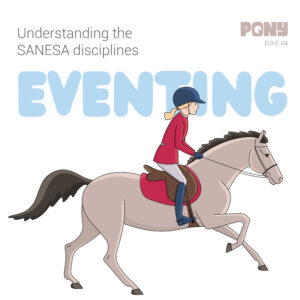
Imagine doing dressage in the morning, galloping cross-country over solid jumps in the afternoon, and finishing with showjumping – all in one day! That’s eventing!
What IS Eventing?
Eventing is an Olympic sport that originated as a cavalry test for military horses. Back in the day, cavalry horses needed to be:
- Relaxed and obedient on parade.
- Responsive to their riders in battle.
- Fit enough to travel at speed across all types of terrain.
- Able to judge any obstacle in their path.
- Strong enough to repeat the whole performance the next day!
Today, eventing is considered the equestrian triathlon because it tests everything: obedience, courage, stamina, endurance, and speed. The horse and rider with the lowest combined penalty score at the end of all three phases wins.
The three phases of Eventing
Eventing consists of three different disciplines, each testing a different aspect of you and your horse:
Phase 1: Dressage
Just like in pure dressage, you ride a set test of prescribed movements in an arena with lettered markers. Judges give you marks based on how accurately, fluidly, and precisely you execute each movement. Your horse needs to be:
- Graceful and supple
- Obedient and responsive
- Calm and attentive
Good news for SANESA riders: you’re allowed to have a caller for the dressage phase (someone who reads out the movements) for all levels up to and including 95cm! Only High School Level 7 (1.05m) riders can’t use a caller.
Phase 2: Cross-Country
This is the most exciting and exhilarating part of eventing for riders, horses, and spectators alike! You and your horse gallop over undulating (hilly) terrain while jumping intimidating solid obstacles. These aren’t like show jumps that fall down – these are permanent structures!
Cross-country obstacles include:
- Ditches: Jumping over or into trenches.
- Banks: Jumping up onto or down from raised platforms.
- Drops: Jumping down from a height (scary but thrilling!).
- Water: Jumping in, out, or through water obstacles.
- Combinations: Multiple obstacles in a row that test technical skill.
- Natural terrain: Hills, turns, tight spaces between obstacles.
Each obstacle tests the courage of both horse and rider. You need to navigate technical questions, judge distances, maintain balance and rhythm, and keep going even when obstacles look intimidating!
The ten-minute box: During the cross-country phase, there’s a ‘Ten Minute Box’ where your horse gets time to cool off and rest before the final jumping phase. This is when you can check they’re okay, offer water, and let them catch their breath.
Time matters! There’s an ‘optimum time’ for cross-country. If you’re too slow, you get 0.4 penalties for each second over the time. If you’re too fast (yes, too fast!), you get 1 penalty for each second under the grace period. So you need to find the perfect pace!
Phase 3: Showjumping
After the rigorous cross-country test, you and your (hopefully not too tired!) horse jump a showjumping course. This tests your horse’s:
- Agility: Can they still be nimble after cross-country?
- Suppleness: Are they still flexible and responsive?
- Obedience: Will they still listen to you even though they’re tired?
This is generally the most nerve-wracking part of eventing competitions. You’ve done well in dressage and had a clear cross-country – now you need to finish cleanly without knocking any rails!
How does scoring work?
Eventing uses a penalty system – the horse-and-rider combination with the lowest combined penalty points at the end of all three phases wins. Lower scores are better!
You accumulate penalties for things like:
- Mistakes in dressage movements
- Being too slow or too fast on cross-country
- Refusals (when your horse says ‘nope!’ at a jump)
- Knocking rails in showjumping
- Going off course
SANESA Eventing levels
Important: There are no Level 0 classes in eventing due to the nature of the discipline. The entry level starts at 65cm or 75cm.
In Eventing, you need to qualify to move up levels. This means getting two ‘MER’ (Minimum Eligibility Requirement) rounds with no jumping penalties in the cross-country phase at the level below before you can move up. This ensures both you and your horse are ready for the next challenge!
Primary School Eventing levels:
- Level 2: 65cm cross-country and showjumping
- Level 4: 75cm cross-country and showjumping
- Level 6: 85cm (must have two MER rounds at Level 4)
- Level 7: 95cm (must have two MER rounds at Level 6)
High School Eventing Levels:
- Level 1: 65cm cross-country and showjumping
- Level 3: 75cm cross-country and showjumping
- Level 5: 85cm (must have two MER rounds at Level 3)
- Level 6: 95cm (must have two MER rounds at Level 5)
- Level 7: 1.05m/1* (must have two MER rounds at Level 6) – this is serious top-level eventing!
Safety first!
Eventing, especially cross-country, requires serious safety equipment:
- Medical cards: COMPULSORY for cross-country! You can print these from the SANESA website. They must be filled in and attached to your arm or ankle with a medical armband. This helps emergency services if anything goes wrong.
- Body protectors: COMPULSORY for cross-country and recommended for showjumping. These are special vests that protect your back, chest, and ribs. Air jackets can be worn ON TOP for extra safety, but they don’t replace a proper body protector!
- Proper boots: Jodhpur boots or long equestrian boots (boots covering your ankle) are COMPULSORY for all three phases
- Helmet: Approved riding helmet with three-point harness (always!)
- Surcingles: Recommended for cross-country (these are overgirths that provide extra security)
- Vest numbers: Must be worn for all three phases. Tie your hair up so it doesn’t hide your number!
Important SANESA Eventing rules
- One event per day: Your horse can only do ONE three-phase event per day – it’s exhausting!
- No sharing horses: Each horse can only be ridden by ONE rider in eventing.
- No cross-entering: You can’t compete in two different levels at the same show.
- Qualify before moving up: Remember those two MER rounds! If you compete at a level you haven’t qualified for, you’ll be disqualified and get no points.
- Reverse qualifications: If your horse gets eliminated on cross-country too many times (two in a row, or three within 12 months), they have to go back to a lower level and get an MER before returning. This is for safety!
What makes a good eventer?
Eventing is the ultimate test of versatility. You and your horse need:
- Obedience: For the dressage phase.
- Courage: To tackle solid cross-country obstacles.
- Stamina: To keep going all day.
- Endurance: Physical fitness for both horse and rider.
- Speed: Galloping cross-country at the right pace.
- Trust: Your horse needs to trust you completely when you ask them to jump into water or over a ditch.
- Fitness: Both you and your horse need to be in good shape.
- Mental toughness: Not giving up when things get challenging.
- Quick thinking: Making split-second decisions on cross-country.
Top tips for SANESA Eventing
- Build fitness gradually: Eventing is physically demanding! Both you and your horse need to be fit.
- Practice all three phases: Don’t just focus on one – you need to be good at all three!
- Learn your dressage test: Even though you can have a caller (up to 95cm), knowing your test helps you ride it better.
- Walk the cross-country course: ALWAYS walk the course before you ride it. Plan your routes, count strides, and decide on your pace.
- Trust your horse: If you’re confident, your horse will be too.
- Don’t rush the levels: Get those two MER rounds before moving up. Qualify properly – it’s for your safety!
- Check all your safety equipment: Body protector, medical card, proper boots – these are NON-NEGOTIABLE
- Learn about pace: Use a stopwatch in training to learn what different speeds feel like.
- Stay calm: If something goes wrong in one phase, you can still make up points in the next phase!
Why try Eventing?
Eventing is perfect for riders who:
- Love variety and don’t want to specialise in just one thing.
- Want the ultimate challenge and test of horsemanship.
- Enjoy the thrill of galloping and jumping solid obstacles.
- Like the idea of an ‘all-rounder’ horse and rider combination.
- Are brave and enjoy adventure.
- Want to compete in something that’s an Olympic sport.
- Have a horse who is good at multiple disciplines.
- Like the idea of really building trust with their horse.
Eventing creates an incredibly special bond between horse and rider. When you ask your horse to gallop at a solid obstacle, and they trust you enough to do it, when you work together through all three phases, when you both finish and realise you’ve accomplished something amazing together – that’s the magic of eventing!
Ready to try the equestrian triathlon?
If eventing sounds exciting (and maybe a little bit scary – that’s normal!), start by:
- Building fitness: Get yourself and your horse in good physical shape.
- Taking lessons: Learn dressage, showjumping, AND cross-country skills.
- Starting small: Begin at Level 2 (Primary) or Level 1 (High School) – 65cm is a great starting height.
- Getting the right gear: Body protector, medical card, proper boots – safety first!
- Walking courses: Go watch an event and walk a cross-country course to see what it’s all about.
Remember: Eventing tests everything – obedience, courage, stamina, endurance, and speed. It’s challenging, exciting, sometimes scary, always rewarding, and absolutely thrilling when you and your horse complete all three phases together!
For more information about SANESA Eventing and safety requirements, visit www.sanesa.co.za

