
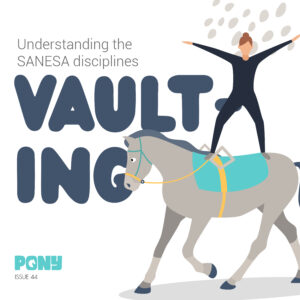
Imagine doing cartwheels, handstands, and flips, but instead of on a gym mat, you’re performing on the back of a cantering horse! That’s Vaulting, and it’s one of the most exciting and accessible equestrian sports you can try.
What is Vaulting?
Vaulting combines gymnastics, dance, and horse riding into one amazing sport. While a specially trained horse canters in a circle (controlled by a person called a ‘lunger’), vaulters perform choreographed moves to music on the horse’s back. You might do shoulder stands, kneeling positions, or even partner moves if you’re competing in pairs!
The best part? Vaulting is the most affordable equestrian discipline because many vaulters can share the same horse during training and competitions. This makes it perfect for schools and riding clubs!
Why try Vaulting?
Vaulting is brilliant for developing skills you’ll use in all riding disciplines:
- Balance: You’ll become super steady in the saddle!
- Confidence: If you can stand on a cantering horse, you can do anything!
- Core strength: Your muscles will get incredibly strong.
- Rhythm and timing: You’ll learn to move in harmony with the horse.
- Teamwork: You’ll work closely with your horse, lunger, and other vaulters.
- Fitness: It’s an amazing full-body workout!
Starting with barrels
Don’t worry if the idea of vaulting on a moving horse sounds scary! SANESA offers full barrel vaulting competitions where you perform all your moves on a stationary barrel (it looks like a big padded barrel on legs). This is the perfect way to learn all the positions and build your strength and confidence before progressing to a real horse.
Level 0 (E Grade): This level is ONLY for barrel work and is perfect for absolute beginners. It’s your Rising Stars Challenge class!
Types of Vaulting competition
At SANESA, you can compete in different types of vaulting classes:
Individual Vaulting
In Individual Vaulting, you perform on your own. There are two parts:
- Compulsories: These are set moves that everyone at your level must perform. The judge is looking at how correctly and smoothly you execute each required position.
- Freestyle: This is where you get to be creative! You design your own routine to music, choosing moves that show off your strengths. You only have one minute, so you have to make it count!
Fun fact: If multiple vaulters are using the same horse, you all perform one after another without stopping. When it’s your turn, you stand behind the lunger waiting for your moment to vault on!
Pairs (Pas-de-Deux)
In Pairs Vaulting, two vaulters perform together on the same horse. You can pair up with anyone (any gender combination), and you’ll perform freestyle routines only – no compulsories! This is where you might lift your partner, create mirrored moves, or perform amazing synchronised gymnastics.
Time limits for pairs:
- Under 15 years: 1½ minutes
- 16 years and older: 2 minutes
Understanding the levels
SANESA Vaulting has different levels based on the VASA (Vaulting South Africa) grading system:
Level 0 – E Grade (Barrel only): Perfect for beginners! Compulsories and freestyle on the barrel. At this level, you don’t get scored for mounting on.
Level 1 – E Grade (Horse): Your first time on a real horse! You’ll perform compulsories and freestyle at the walk (not canter yet). Again, no score for mounting on.
Level 2 – D Grade (Barrel): Getting more advanced on the barrel with harder moves.
Level 3 – D Grade (Horse): Now you’re cantering! Compulsories at canter, freestyle at walk. This is where Vaulting gets really exciting!
Level 4 – C Grade (Barrel): Advanced barrel work, preparing you for C Grade on the horse.
Level 5 – C Grade (Horse): Both compulsories and freestyle at canter! You’re performing like a proper vaulter now.
Level 6 – 1* Grade: Expert level with complex moves and high difficulty.
Level 7 – 2* Grade: The highest level! Only available for High School. This is championship-level Vaulting.
What you’ll wear
Vaulting has specific dress requirements to keep you safe and help judges see your movements clearly:
For Compulsories:
- Fitted sports clothing (school PE kit is perfect!)
- Your outfit must not hide your body’s form – judges need to see if you’re in the correct position.
- Neat, controlled hair (no loose hair flying about).
- NO sharp or hard hair accessories (safety first!)
- Number on your right leg, right arm, or back (10-12cm height, black and white or matching your outfit)
For Freestyle:
- You can be more creative and wear themed costumes!
- Still must be form-fitting.
- All clothing must stay attached to your body.
- Decorative accessories must be soft and flexible (no hard materials).
- Your face must be visible (no masks, and only ¼ of your face may be painted).
- Your outfit should NOT look like you’re nude!
Types of Vaulting exercises
Vaulting exercises fall into two main categories:
Static exercises
These are positions you hold still on the horse, and maintain balance while the horse canters beneath you. Examples include:
- Sitting positions (like the basic seat)
- Kneeling positions
- The flag (one leg out behind you)
- Shoulder stands
- Handstands
To count as a static exercise, you must hold the position for at least three canter strides or four walk strides – and maintain harmony with the horse’s movement!
Dynamic exercises
These are movements where your body is moving and changing position. Examples include:
- Mounting on and dismounting
- Cartwheels and flips
- Moving from one position to another (transitions)
- Mill (swinging your legs around in a circle)
- Scissors (swapping your legs’ positions)
Important: In dynamic exercises, you must stay upright above the horse’s back. If you lean too far or lose control, it counts as a fall!
How Vaulting is judged
Judges look at several aspects of your performance:
Performance/Technique Score
How well did you execute each move? Were your positions correct? Did you hold them long enough? Were your landings smooth?
Artistic Score
How creative was your freestyle? Did your moves flow together? Did you use music well? Did you move around the horse in different positions?
Degree of Difficulty
At certain levels (D Grade and 2* Grade), judges score the difficulty of your moves. The 10 most difficult moves you perform are counted toward this score.
Horse Score
The horse’s performance matters too! Judges assess whether the horse maintained a steady rhythm, whether he was calm with the lunger, and the overall quality of his movement.
Scoring uses marks out of 10: 10 = excellent, 9 = very good, 8 = good, 7 = fairly good, 6 = satisfactory, 5 = sufficient, and anything below 5 means the exercise needs improvement!
Falls and deductions
A fall is when you lose control of a movement. Falls are marked with an ‘F’ on your scoresheet and points are deducted from your performance score. The amount of deduction depends on the type of fall:
- Small loss of balance (but you recover quickly)
- Touching the horse’s neck or body to regain balance
- Completely losing contact with the horse
- Falling to the ground
Don’t worry! If you fall, you have 30 seconds to get back on and continue. The judge will ring a bell, and the music and timing will stop until you’re ready to continue.
Music and timing
All Vaulting is performed to music (songs with words are allowed!). When it’s your turn for freestyle, you signal to the judge that you’re ready for your music to start. Your time begins the moment you touch the horse, handles, or pad – even if your music hasn’t started yet.
Choose music that:
- Matches your routine’s mood and style
- Has a clear rhythm you can move to
- Fits within your time limit (one minute for individuals!)
- Shows off your personality
Understanding the bell
Judges use a bell to communicate with you during your round. Here’s what it means:
- One bell: Enter the arena, or start your test, or time is up!
- Bell after a fall: Music and timing stopped – you have 30 seconds to continue
- Bell during your routine: Something needs attention (equipment issue, music problem, or the horse needs checking)
Important rules to remember
- All Vaulting is performed on the left rein (horse circles to the left) unless told otherwise.
- Always salute the judge when entering AND exiting the arena.
- Only three people are allowed in the Vaulting circle at once: the lunger, the competing vaulter, and an assistant (only for walk rounds and barrel classes).
- You can compete in one horse class at your current level AND one barrel class at your level or one level higher at any show.
- Compulsory moves cannot be repeated in freestyle during the same grade unless performed in a different direction or position.
- If an exercise isn’t held long enough, it won’t count toward your difficulty score (but you won’t automatically lose points).
Top tips for Vaulting success
- Build your strength: Core strength is EVERYTHING in Vaulting. Practice planks, sit-ups, and handstands at home.
- Work on flexibility: The more flexible you are, the easier the positions will be. Stretch regularly!
- Feel the rhythm: Learn to count the horse’s canter strides. 1-2-3, 1-2-3… Move with the horse, not against it.
- Practice on the barrel first: Master each position on the barrel before trying it on the horse. It’s much less scary!
- Plan your freestyle carefully: One minute goes FAST! Make sure every move counts and flows smoothly into the next.
- Keep moving around the horse: Judges want to see you use different positions – facing forward, backward, sideways, upside down!
- Smile and perform: Artistic impression matters! Show confidence and enjoy your routine.
- Trust your horse: Vaulting horses are specially trained and incredibly steady. Relax and let them do their job!
Why Vaulting is extra special
Vaulting is unique because it’s inclusive and accessible to everyone. The sport helps build physical strength, mental confidence, and emotional well-being – all while having amazing fun with horses!
Plus, because you don’t need your own horse, vaulting is the perfect way to get involved in the equestrian world without the expense of horse ownership. Your club provides the horse, and you provide the effort and enthusiasm!
Whether you vault on a barrel or on a cantering horse, whether you compete alone or with a partner, Vaulting will make you stronger, more confident, and give you a special connection with these incredible animals.
Ready to give it a go?
If you love gymnastics, if you love horses, or if you just want to try something completely different and exciting, Vaulting is for you! Start on the barrel, build your confidence and skills, and before you know it, you’ll be performing cartwheels on a cantering horse!
Remember: every amazing vaulter started exactly where you are now – on the ground, looking up at the horse and thinking “I’m going to stand on THAT?!” With practice, patience, and perseverance, you absolutely can.
Happy vaulting!
For more detailed rules and regulations, visit the SANESA website or check out Vaulting South Africa (VASA) guidelines. Speak to your coach about which level is right for you!

